
How Can Financial Advisors in San Francisco Use Client Testimonial Videos to Build Trust?
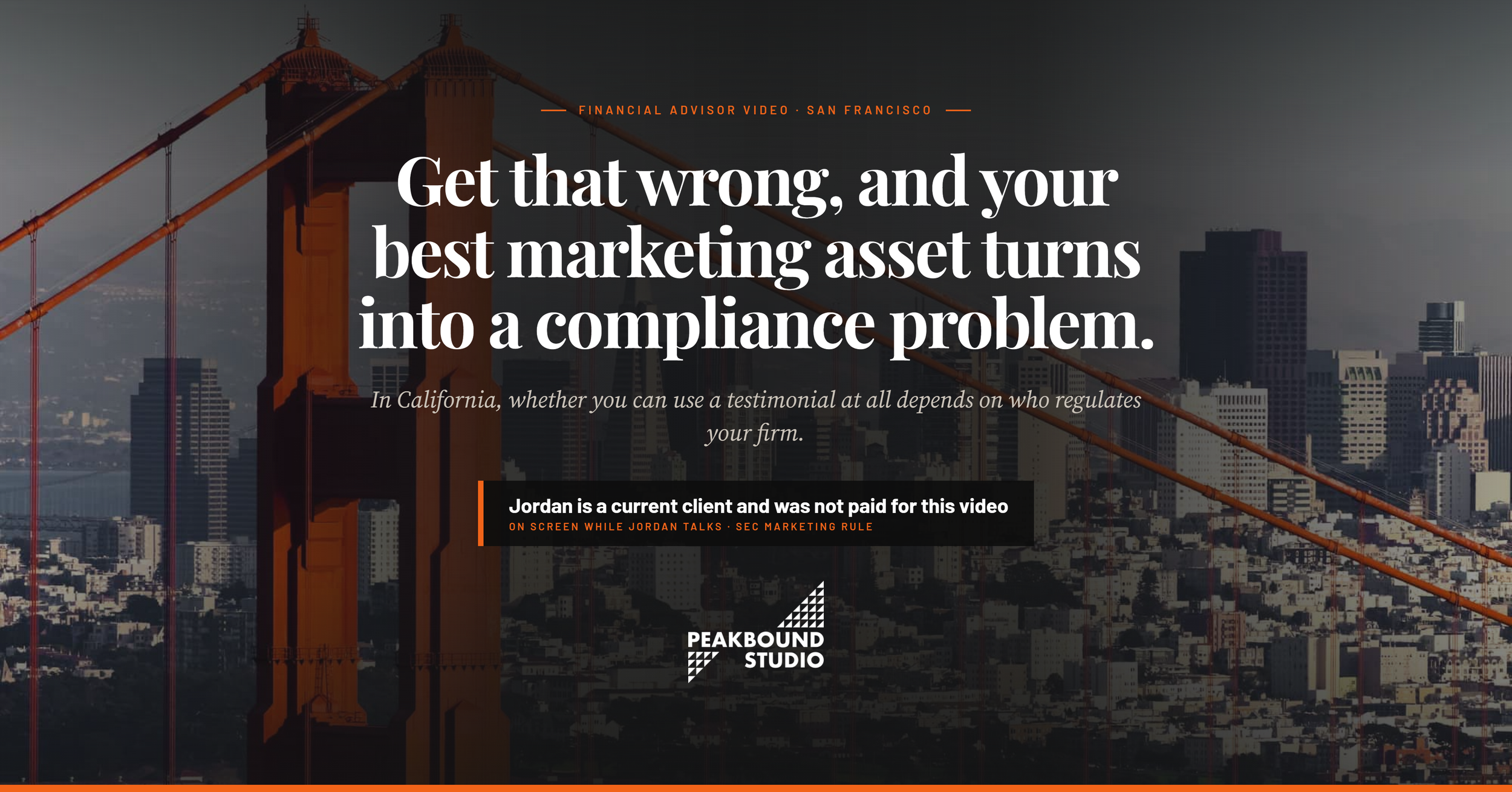
The Golden Gate Bridge tower in front of the San Francisco skyline
A 34-year-old engineer in SoMa just watched her company go public. Now she's sitting on stock she doesn't fully understand, and she's scared of making a costly mistake. She finds three advisors online. All three have nice websites. All three say they put clients first.
So who does she call?
Odds are, the one where she can watch a real client talk about what it's like to work with them. That's the power of a testimonial video. It lets a stranger borrow someone else's trust.
But here's the catch most articles skip. In California, whether you can use a testimonial at all depends on who regulates your firm. Get that wrong, and your best marketing asset turns into a compliance problem.
Financial advisors in San Francisco can build trust with client testimonial videos by letting real clients talk about what it's like to work with them, not about returns. SEC-registered advisors can use testimonials if they clearly show whether the speaker is a client, whether they were paid, and any conflicts. Advisors registered with the state face a California rule that still bans testimonials, so they should check with compliance before filming.
Key takeaways
- SEC-registered advisors have been allowed to use testimonials since November 4, 2022, as long as they follow the disclosure rules.
- California's own rule for state-registered advisors still bans testimonials of any kind.
- A new national model rule could change that, but it isn't law in California until the state adopts it.
- The best testimonials focus on how it felt to work with you. Not on returns.
- Every clip needs its disclosures, even a 30-second social cut.
Are financial advisors allowed to use client testimonials?
For decades, the answer was no. The SEC's advertising rule from 1961 simply didn't allow them.
That changed with the SEC Marketing Rule, also called Rule 206(4)-1. The SEC adopted it in December 2020, and firms had to follow it by November 4, 2022. According to the SEC's own compliance guide, it lets SEC-registered advisors use testimonials and endorsements. But they have to meet rules on disclosure, oversight, and who can speak for them.
And yes, video counts. The rule covers your website, your social posts, and your videos, just like print ads.
So if your firm is registered with the SEC, a client testimonial video is on the table. But in California, that "if" is doing a lot of work.
Why does it matter who regulates your firm in California?
Here's the part that trips up a lot of Bay Area advisors.
In California, firms with less than $100 million in assets under management usually register with the state, not the SEC. That means the Department of Financial Protection and Innovation, or DFPI.
And the state's ad rule for those firms still bans any ad that refers to a testimonial about the advisor.
"...which refers, directly or indirectly, to any testimonial of any kind concerning the investment adviser..."
California Code of Regulations, Title 10, Section 260.235(a)(1)
So two advisors on the same block of Montgomery Street can face totally different rules. One can post a client video tomorrow. The other can't.
There is some good news. On May 4, 2026, NASAA voted to update its model rules on advisor ads. NASAA is the group made up of state securities regulators. The new model rules would let state-registered advisors use testimonials, with guardrails much like the SEC's.
But a model rule isn't a law. It only counts in California once the DFPI adopts it. As of this writing, we haven't found any sign that it has.
| Who regulates you | Can you use testimonial videos? | Main rules to follow |
|---|---|---|
| SEC-registered advisor | Yes, with conditions | SEC Marketing Rule |
| California state-registered advisor | Not under the current state rule | 10 CCR 260.235 |
| Broker-dealer rep | Yes, with conditions | FINRA Rule 2210 |
| Dually registered | Yes, if you meet both sets of rules | SEC and FINRA rules together |
Not sure which group you're in? Your Form ADV will say. And your compliance officer will know for sure.
What has to appear in a compliant testimonial video?
Quick note first. We're a video studio, not a law firm. So use this as a checklist to go over with your compliance team, not as legal advice.
Under the SEC rule, the video has to clearly and prominently show three things. Is the speaker a current client? Were they paid or given anything of value? And are there any conflicts of interest?
If you pay someone more than $1,000 in a year for a testimonial, you also need a written agreement with them. Most advisors don't pay clients at all. That's the cleanest path.
If you're also a broker-dealer rep, FINRA Rule 2210 adds its own list. A testimonial about your advice or results has to say it may not reflect other clients' experience. It also has to say it's no promise of future results. And if the person got more than $100 in value, you have to say it's a paid testimonial.
Then there are the SEC's basic rules for every ad. Nothing untrue or misleading. If you talk up a benefit, you have to be fair about the risks. And you have to keep a copy of every ad you put out.
So what does "clearly and prominently" look like on video? Many firms put the disclosure on screen while the client is talking, in text that's easy to read on a phone. A line buried in the YouTube description is a risky bet.
The SEC does enforce this. In September 2024, it settled charges against nine advisory firms for breaking the Marketing Rule. Some of the ads had testimonials without the required disclosures. The nine firms paid $1.24 million in penalties combined.
Do this
- Show "Jordan is a current client and was not paid for this video" on screen while Jordan talks.
- Let clients talk about how clearly you explain things.
- Get compliance sign-off on every cut before it goes live.
Don't do this
- Let a client say "My portfolio beat the market by 12 percent."
- Post a short social clip without the disclosure.
- Hint that every client gets the same results.
What should clients talk about on camera?
Here's where testimonials get better, not just safer.
The strongest advisor testimonials aren't about returns. Every prospect expects you to claim good returns anyway. And talking about them is the fastest way into trouble.
What prospects can't get from your website is what it feels like to work with you. (There's real psychology behind why testimonials work, and most of it comes down to seeing someone like yourself.) So steer the interview toward questions like these:
- What was going on in your life when you first called?
- What were you most worried about?
- How did your advisor explain things?
- What surprised you?
- How do you feel about money now?
In San Francisco, the stories often tell themselves. A founder figuring out what to do after selling a company. A couple trying to raise kids and pay a Bay Area mortgage. A tech worker holding stock options they never understood. A new retiree who wanted a plan they could actually follow.
People can see themselves in those moments. And none of them need a single performance number.
| Say this | Not this |
|---|---|
| "I finally understand my stock options." | "She got me out before the stock dropped." |
| "He always calls me back the same day." | "My returns have been amazing." |
| "I sleep better knowing we have a plan." | "You'll never lose money with them." |
How do you get clients to say yes to being on camera?
Money is private. Plenty of clients will love you and still say no to a camera. That's normal, so don't take it personally.
A few things help. Start by asking clients who already send you referrals. They're usually the most willing. Offer privacy choices, like first name only, no employer, and no account details on screen. And tell them how it works. Compliance reviews the final video, and they'll get to see it before it goes live.
Most of all, don't script them. Scripted lines sound stiff. People can tell. And putting words in a client's mouth makes a testimonial less honest, which is the opposite of the point.
That's the heart of how we work at Peakbound. Every video we make is documentary style and built around real interviews. We ask good questions, help nervous people relax, and let real answers carry the story. Some of the best testimonials come from people who swore they'd be terrible on camera.
Where should financial advisors use testimonial videos?
One good shoot can feed a lot of places:
- Your homepage or About page, where first impressions form.
- Service pages, like retirement planning or stock option planning.
- LinkedIn, as short cuts of 30 to 60 seconds.
- Follow-up emails after a first meeting, while a prospect is deciding.
- Screens at seminars and client events.
Just remember that every version counts as a new ad. Each cut needs its own disclosures, its own compliance review, and a saved copy. Plan for that before the shoot, so there's room for disclosures in every version.
Quality matters too. In Wyzowl's 2026 survey, 89 percent of people said video quality affects how much they trust a brand. In a field built on trust, a shaky phone video sends the wrong message.
What if you're state-registered and can't use testimonials yet?
You still have strong options. Video can build trust without a client saying a word about you.
Try a brand video where you tell your own story. Why did you become an advisor? Who do you love helping? Or make a process video that walks prospects through what the first few months look like. Short videos that answer the questions you hear every week work well too.
These let prospects see your face and hear your voice before the first call. That alone takes a lot of the fear out of reaching out. And if California adopts NASAA's new rules, you'll be ready to add client stories to a video library that already works.
Frequently asked questions
Can financial advisors use video testimonials?
Yes, if they're registered with the SEC. The SEC Marketing Rule has allowed testimonials since November 4, 2022, as long as the video clearly shows whether the speaker is a client, whether they were paid, and any conflicts. Advisors registered only with California face a state rule that still bans testimonials.
Can state-registered advisors in California use client testimonials?
Not under the current rule. California's ad rule for state-registered advisors bans testimonials of any kind. NASAA adopted new model rules in May 2026 that would allow them, but California has to adopt those rules before anything changes. Check with your compliance officer.
Do I have to pay clients to appear in a testimonial video?
No. Most advisors don't pay at all. Paying a client adds more rules, like extra disclosures, and a written agreement if you pay more than $1,000 in a year.
What disclosures does a financial advisor testimonial video need?
Under the SEC rule, it has to show whether the speaker is a current client, whether they were paid, and any conflicts of interest. Broker-dealer reps also need FINRA's disclosures. Those say the testimonial may not reflect other clients' experience and isn't a promise of future results.
How long should a financial advisor testimonial video be?
For your website, one to two minutes is a good target. That's enough time for a real story. For social media, cut shorter clips of 15 to 60 seconds from the same interview, each with its own disclosure.
How much does a testimonial video cost in the Bay Area?
It depends on how many clients you film, where you shoot, and how many versions you need. At Peakbound, projects start at $2,500, with packages built around your goals.
Ready to tell your story?
If you don't tell your story, someone else will.
For financial advisors, that someone is often a review site, a competitor, or a blank space where trust should be.
Peakbound Studio makes documentary-style testimonial and brand videos for firms across San Francisco and the Bay Area. We'll help you plan a shoot that fits your compliance review from day one.
Plan your testimonial videoSources
- SEC, Investment Adviser Marketing: A Small Entity Compliance Guide
- Cal. Code Regs. Tit. 10, Section 260.235, Advertisements by Investment Advisers
- NASAA, Modernizes Investment Adviser Advertising Rules (May 4, 2026)
- FINRA Rule 2210, Communications with the Public
- SEC Press Release 2024-121 (Sept. 9, 2024)
- Wyzowl, Video Marketing Statistics 2026
- Shartsis Friese, California DFPI Compliance Filing Requirements