A Silver Telly for Narration, and What It Took to Earn It
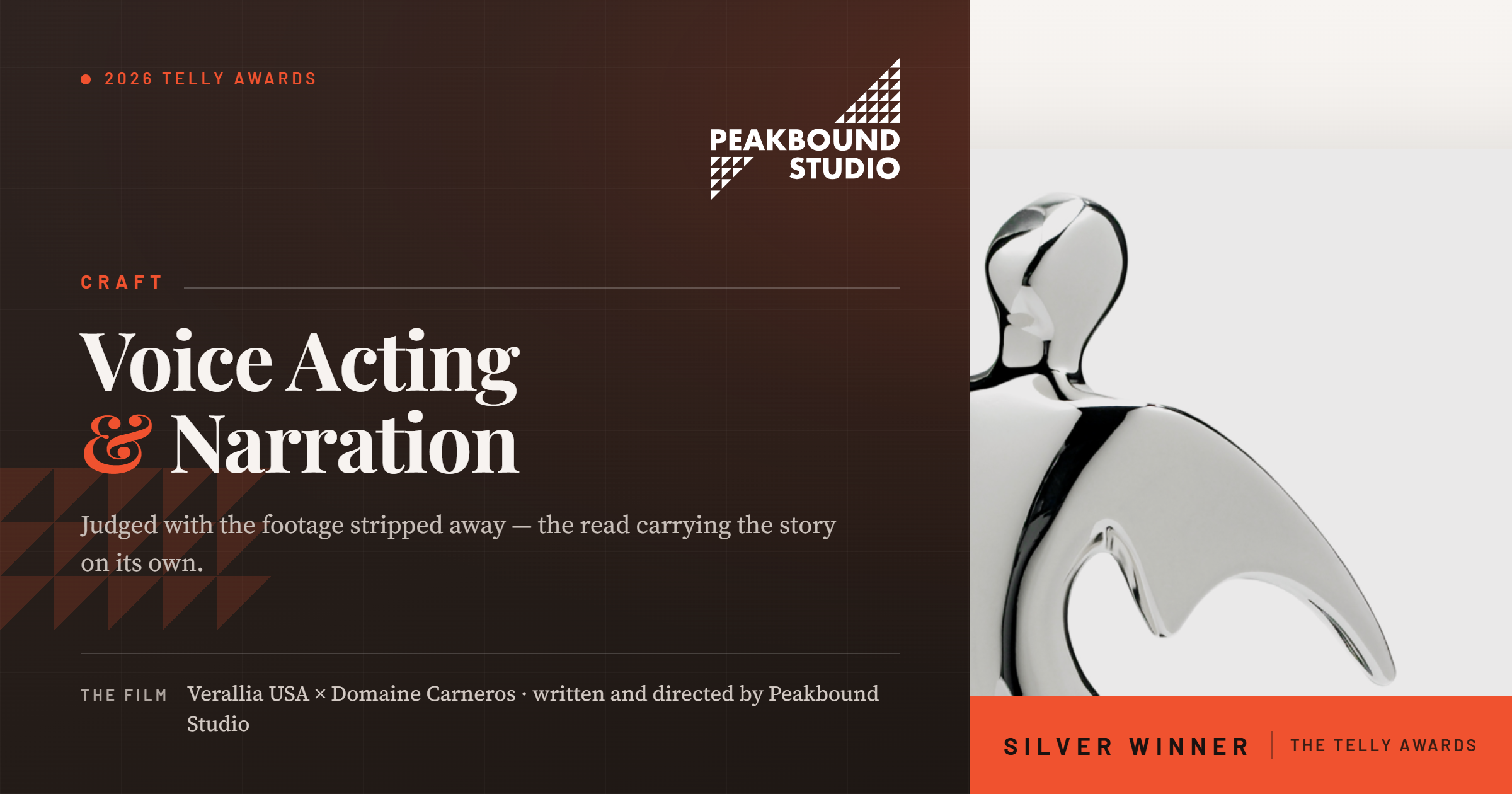
Silver Telly Award · Craft: Voice Acting & Narration
A few weeks ago we found out our video for Verallia and Domaine Carneros won a Silver Telly Award. Not Best Video. Not Best Branded Content. Craft: Voice Acting & Narration.
The short version
A Telly craft category scores one element of a video rather than the finished piece. So this award reflects the script and the read on their own, not the footage, the edit, or the color grade.
Getting there took reviewing 30 to 40 voice actors, three full passes through the script, and another 5 to 10 takes on the lines that mattered most. If you want to judge a production company before you hire one, narration is the fastest tell, and we explain how to test it below.
What does a Telly craft category actually measure?
It measures one skill in isolation. An entry in Voice Acting & Narration is judged on the narration, meaning the script and the read, against every other narration entered that year. The edit isn’t being scored. Neither is the camera work. Just whether the words and the delivery hold up on their own.
It’s a small award. It also happens to line up with the part of the job we spend the most time on.
Why narration is where you can tell production companies apart
Because narration is the one thing nobody can hide behind. Everyone shows up with a good reel. Drone shots, slow pans, color grading that looks expensive.
What almost nobody shows you is what happens when you take the visuals away and just listen.
Most corporate narration sounds the same with your eyes closed. A pleasant, slightly flat voice reading copy that could belong to any company in any industry. It’s not bad. It’s just not doing anything.
We think that’s the real gap in this business. Anyone can point a camera at a bottling line. Getting someone to care about it, using nothing but voice and pacing, is a different skill.
What was the video about?
A lighter bottle. The video was for Verallia USA, the glass packaging manufacturer, and their partnership with Domaine Carneros, the Napa sparkling wine house.
On the surface the subject was bottle weight. Not a thrilling premise.
What Verallia built for Domaine Carneros was an 830-gram sparkling wine bottle. That’s about 9% lighter than the 900-gram standard most U.S. Traditional Method producers use.
But the weight isn’t the hard part. The hard part is that a sparkling wine bottle has to hold up to 100 psi of internal pressure and not fail. Take 70 grams of glass out and it still has to do that, still has to survive shipping, and still has to look like something you’d put on a table at a nice restaurant. That’s the engineering problem. “Lighter bottle” doesn’t really cover it.
It connects to a bigger push at Verallia too, including their first all-electric glass furnace, which Verallia says cuts CO2 emissions by 60% compared with a traditional furnace.
Domaine Carneros’ CEO, Remi Cohen, has described the bottles as providing the durability their sparkling wines need, which sounds like a small thing to say until you know what the pressure spec is. That’s a real constraint the winery lives with, and it’s the kind of detail that gets flattened into corporate mush the moment a script tries to summarize it in fifteen seconds.
Part of why this was hard: sustainability claims in wine and packaging get made so often that people tune them out on instinct. Say “eco-friendly” in a video and most viewers assume gloss before they assume substance.
The only way through that is specificity. An exact number instead of “lighter.” A pressure spec instead of “durable.” The winery’s CEO describing the requirement in her own words instead of a voiceover asserting it. And a read that sounds like someone explaining an engineering decision rather than selling one.
We’d worked with Verallia once before, on a project with the pudding brand Petit Pot, so this wasn’t our first time finding their tone. Domaine Carneros is a different animal. It’s an established Napa estate with decades of its own brand voice and its own long-running sustainability story. A narration that sounded right for a glass manufacturer wouldn’t automatically sound right for the winery. Writing one script that could carry both without tipping too far toward either was most of the actual job.
How do you cast and direct a voice actor?
Slowly, and with a specific brief. Here’s what it looked like on this project.
What it took
- 30 to 40 voice actors reviewed
- 3 full passes through the script
- 5 to 10 extra takes on the lines carrying the most weight
Thirty to forty actors sounds excessive for a script that runs a few minutes, until you consider the brief. The read had to sound premium without sounding like a luxury car ad. And it had to sit alongside Remi’s own voice in the piece. Complement her, not compete with her.
A voice that’s too polished makes the executive sound less authoritative by comparison. Too casual and the whole thing stops feeling like a premium product. That’s a narrow target, and you don’t hit it by listening to five demos.
We landed on Megan. We recorded remotely over Zoom while she worked from her home studio, which is standard now and sounds better than most people expect.
Then we ran the script three times through, start to finish. After that we went back and did another 5 to 10 takes on the lines that were carrying the most weight: the pressure spec, the weight comparison, the close.
Megan was a genuine pro about all of it. That matters more than people think. A voice actor who takes direction well and doesn’t get precious about the tenth take is the difference between a read that’s fine and a read that’s right.
None of this shows up on screen. It’s just where the time went.
How do you judge a video production company’s reel?
Listen to it instead of watching it. Most of the obvious questions assume you can already judge the answer. Whether the footage looks good, whether the editing is clean. You can mostly tell. Narration is where you can tell even if you’ve never worked in video.
Play one of their past projects with your eyes closed. Does it hold up as a story on its own, or does it need the pretty shots to cover a flat read?
Ask why they made a specific choice in the script or the direction, not just what the choice was. A team that can only describe what they did usually didn’t think hard about why.
Ask how the project started. With a shot list, or with real questions about what changed and who felt it? Ours started with the second one, which is what pre-production is actually for, and most of the reason there was a story worth directing.
Ask who wrote the interview questions or the script draft. If it was someone who’s never had to defend a business decision to a client or a board, the narration usually sounds like it. The projects that survive with the visuals stripped away tend to be the ones where whoever wrote the words understood the stakes of the decision being described, not just the industry it happened in.
Frequently asked questions
What is a Telly Award, and why does a craft category matter?
The Telly Awards are one of the longest-running honors in video and television production. The craft categories, like narration, editing, and cinematography, judge one specific skill separately from the finished piece. A craft win means that one element held up against a national field, not just that the overall video looked polished.
Why does narration matter this much in B2B or industrial video?
Because the subject matter usually isn’t visually dramatic on its own. Manufacturing, sustainability data, technical specs. The narration ends up doing most of the emotional work. Get it wrong and it reads like a spec sheet with b-roll. Get it right and the same facts feel like a story.
How do you choose a voice actor for a corporate video?
Start from the brief rather than the demo reel. Decide what the read has to do, who else’s voice it sits next to, and how formal the brand can afford to sound. Then audition widely. On this project we reviewed 30 to 40 actors before recording, because the narration had to complement a client executive’s own voice without overpowering it.
What does Peakbound do differently with narration?
We treat it as a directing job rather than a voiceover order. That means casting deliberately instead of taking the first workable demo, writing for how a line will actually be delivered, directing the read the way we’d direct someone on camera, and cutting picture to match the narration instead of laying a voice track over a finished edit.
Who does Peakbound work with?
Mostly businesses in the $1M to $25M range: marketing and communications agencies who bring us in as their production partner on client work, professional services firms, manufacturers, and SaaS companies.