
Here's a number worth sitting with, and it should bother any SaaS founder who has watched a good deal go quiet for three weeks.
When Gartner looked at how B2B buyers spend their time, it found they give about 17% of it to meetings with sellers, and since they're usually weighing a few vendors at once, any one of you may only get 5% or 6%. That stat gets quoted a lot.
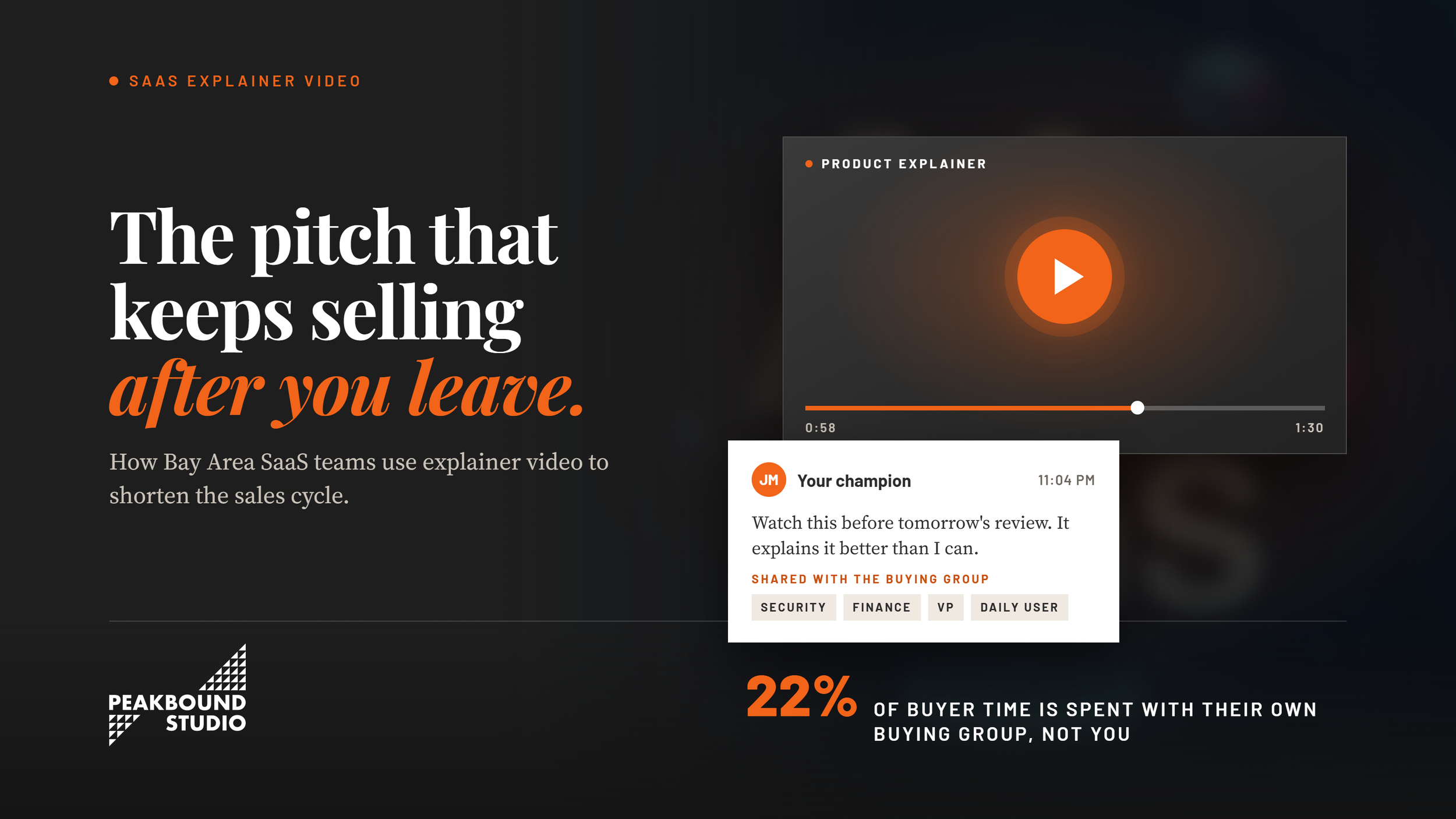
The number sitting right next to it almost never does, though, which is that buyers spend about 22% of their time in meetings with their own buying group.
So the biggest block of time when your product gets talked about isn't your demo at all but a meeting you can't attend. Someone liked your pitch enough to repeat it, and now they're doing it from memory to five people who each want something different.
That's where deals go quiet, and it's the exact problem a good explainer video fixes.
Quick answer
Explainer videos shorten SaaS sales cycles because they keep selling when nobody from your team is in the room, and that matters since most of a B2B deal gets settled in private meetings and late-night solo research. When your champion can just hit play on a short, clear video instead of trying to explain the product from memory, a lot of the back-and-forth that drags deals out never happens at all.
- With all sellers
- 17% of buyer time
- With their own team
- 22% of buyer time
- Buying group size
- 6 to 10 people
Why do SaaS sales cycles stall?
Deals stall because the buying group can't agree, which leaves your champion selling for you without any of your help.
Gartner puts a buying group for a big purchase at six to ten people, and each one shows up with four or five facts they dug up on their own, so it's no surprise they don't agree with each other.
The security lead cares about SOC 2, the finance lead wants to know what happens at renewal, and the person who'll use the thing every day just wants to know if it makes Tuesday easier.
Your champion has to answer all of them at once, in a meeting you'll never see, using a version of your pitch they half-remember from a call six weeks ago.
In the Bay Area, that job is harder than most because buyers here sit through more pitches, run more pilots, and have been burned before by a tool that never stuck, so the bar for a yes is higher and more people get to say no.
Gartner also found that about 77% of buyers call their last purchase very hard, and getting people to agree is the worst part of it. That means this isn't a selling problem you can fix with one more email but a translation problem, and video happens to be very good at those.
What does an explainer video do that a demo can't?
A demo needs you in the room, but a video doesn't, so it can travel into the talks that decide the deal.
Live demos are great, and you shouldn't stop doing them, but a demo only reaches whoever shows up, it leans on your rep having a good day, and nobody can forward it.
A video can be dropped into a Slack thread at 11pm. From there it might land in the security review, get tucked into the email your champion sends their VP, or play on somebody's laptop in a Mountain View meeting room while you're asleep, and it'll tell the story the same way every single time.
If a prospect has ever described your product back to you and you thought "that's not quite it," you've seen what happens when the pitch travels by memory.
Which explainer videos shorten the cycle?
There are four of them, and each one answers a different thing your buying group is stuck on.
Most firms make one video, put it on the home page, and stop there, which is a fine start but leaves the hard parts of the deal with no help at all.
| Video | The job it does | Length |
|---|---|---|
| The 90-second what-it-is | Brings a new face on the buying group up to speed | 60 to 90 seconds |
| The problem video | Helps your champion make the case for acting now | 2 to 3 minutes |
| The objection answer | Settles worries about safety, pricing, or switching | 2 to 4 minutes |
| The customer story | Gives doubters proof from someone like them | 2 to 3 minutes |
The objection answer is the one almost nobody makes, even though it's the one that tends to unstick a dead deal. Say your reps field the same question about where data is stored on every call. That answer should exist as a link your champion can forward, because right now it means booking another meeting with your engineer, and there goes a week.
The customer story works for much the same reason. Your champion can say you're good, but they can't say you're proven. Someone doing their job at a firm like theirs can, and they don't need you scrambling to set up a reference call first, which on its own tends to tack another week or two onto the deal.
So how long should a SaaS explainer video actually be?
Keep the first one under 90 seconds, and save the two-to-four-minute runs for the deeper videos once they've earned it.
Wistia's 2026 State of Video Report found that clips under a minute hold about 52% engagement, which in plain terms means viewers get through roughly half. So if the line you most need a CFO to hear lands two minutes in, most of them never hear it.
There's a real urge to go too far the other way, and plenty of agencies will tell you to cut it all to thirty seconds, but don't. Wistia also found that teaching content holds people well at longer lengths, since viewers will stay with a video that answers their question. So the rule isn't "short." It's "no longer than the job needs."
Where should these videos live?
On the pages where buyers read up on you alone, and in the hands of your reps as something to send.
The website half is the obvious one, so put the short video near the top of your home page and your product pages, since that's where it gets the most plays. We've written more on how landing page video affects conversion if you want the proof rather than the usual claims.
The sales half is where most Bay Area teams leave money on the table, and there are four spots worth building into your process:
- The follow-up email after a first call, so your champion has something to forward that night
- The security review, where a short tech video saves a whole round of questions
- Cold outreach, since a 60-second video gives a stranger a reason to reply
- Onboarding, where the same video cuts the hand-holding your CS team does later
That last one is a nice bonus, since a video built to speed up the sale tends to speed up setup too. After all, the confusion it clears up is the same confusion new users run into during their first week.
How do you stop an explainer from sounding like every other SaaS video out there?
Film real people instead of a cartoon, because the whole field has been drowning in the same slick voiceover for a decade.
You know the template. Pastel shapes sliding around, upbeat ukulele, a voice that sounds like it's smiling too hard, and a script with the word "seamlessly" in it. Those videos aren't bad so much as forgettable, and a buying group in San Francisco has watched forty of them this quarter.
We shoot documentary-style, which really just means we work from interviews rather than scripts. We'll sit your founder or head of product down, ask them the questions your buyers keep asking, and then trim their answers until there's nothing left to cut. What comes back sounds like a person who knows the problem, and that rings true in a way a polished voice never does.
It's faster for you, too, since nobody has to write and approve a script, and on top of that, most people come across far better answering a question off the cuff than they do reading their own words off a teleprompter.
How can you tell if it's working?
Skip the view counts and look at how long deals take when a rep sent the video versus when they didn't.
Views on their own won't tell you much, but the numbers that do matter are already sitting in your CRM:
- Days from demo to close, split by whether the video was shared
- How often deals slip back a stage, which usually means someone was never brought up to speed
- Reply rate on cold outreach with and without video
- How many reference calls your team sets up per closed deal
One cheap way to start is to have reps tag the deals where they sent a video. You don't need any new software for it either, since a single checkbox in your CRM gives you a clean split you can read later on.
Give it a quarter before you judge it, since sales cycles run long enough that a month of data won't tell you much that's true, and anyone promising a clean before-and-after in thirty days is selling you something.
Where these numbers come from. The buying group and time figures come from Gartner's B2B buying journey research, while the watch time and length numbers are from Wistia's 2026 State of Video Report.
Key takeaway
- Since most of a B2B deal gets hashed out in meetings you don't attend, your champion needs something they can pass around without you there.
- Buying groups tend to run six to ten people deep, and every one of them is hung up on something different.
- Most of the heavy lifting comes from four videos, which are the short what-it-is, the problem piece, the objection answer, and the customer story.
- The objection answer gets skipped more than any of the others, even though it's often the one that helps the most.
- Keep the first video under 90 seconds, and only let the deeper ones run longer once they've earned it.
- Interview-led video gets noticed, mostly because almost everyone else is still leaning on the same cartoon template.
- What you really want to track is how long deals take, not how many people hit play.
Questions we hear a lot
How long does it take to produce a SaaS explainer video?
Most projects take somewhere between two and four weeks from kickoff to final cut, though it really comes down to how many videos you want and how quickly your notes come back to us. The good news is that a single interview day can often give you several finished pieces.
Do explainer videos work for technical products?
Yes, and often better than for simple ones, because the harder your product is to explain, the more your champion is going to struggle explaining it for you, and technical buyers usually trust a real engineer walking them through it far more than a cartoon.
Should we animate or film real people?
Film real people when trust matters, which in B2B it almost always does. Cartoons suit abstract ideas with nothing to show, but they're also what most of your competitors are already doing, which means they rarely help you stand out.
What does a SaaS explainer video usually cost?
That depends on how many shoot days you need, how big the crew is, and how many finished pieces you're after. Our projects start at $2,500, and most teams find they get a lot more for their money by filming several videos in one day rather than ordering them one at a time.
Can one video cover the whole buying group?
Rarely, because one video can get everyone to the same starting point, but the security lead and the daily user are worried about very different things, so you'll want a short piece aimed at each.
Where should a SaaS explainer video go on our website?
Near the top of the home page, and on each product page, with a click-to-play thumbnail, since that's where play rates are highest and where buyers reading up on you spend their time.
Ready to make something your champion can forward?
We're a documentary-style video company in downtown Oakland, so we can film in SF, the Peninsula, or the East Bay without billing you for a travel day. We tend to start by asking which question your reps are tired of answering, since that's usually the video worth making first.
Take a look at how we work with tech and SaaS teams, or at our video strategy process. We also film across San Francisco and the wider Bay Area.