
Do Video Ads Really Outperform Static Ads for Bay Area Businesses?
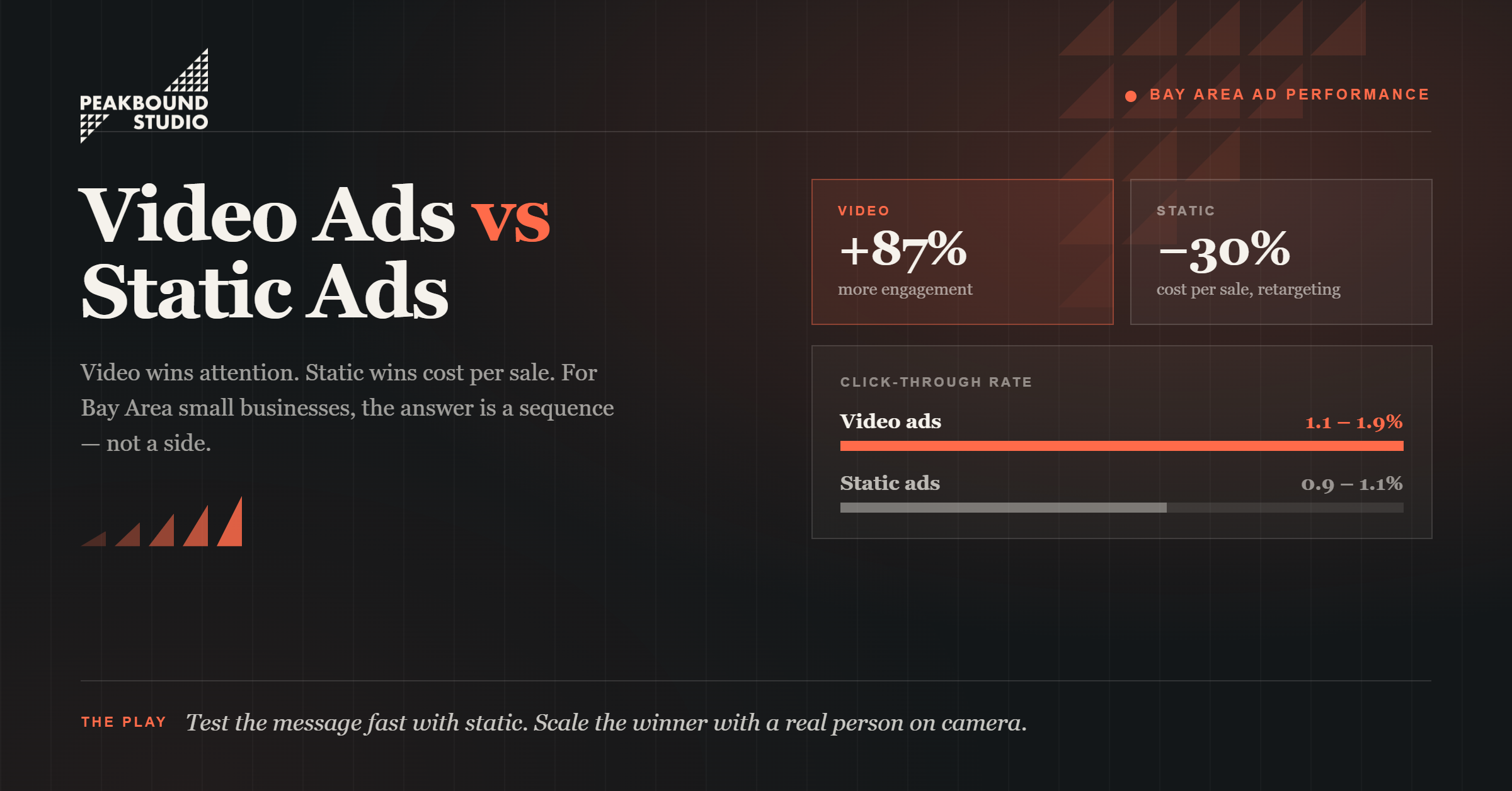
Image credit: Peakbound.studio
If you run a business in the Bay Area, you already know this: your ad money doesn't stretch far here. There's a lot of competition. And people scroll right past anything that feels generic. So when it's time to pick between a video ad and a static ad, this isn't just a fun question. It's a real money decision.
TL;DR
Video ads usually beat static ads for Bay Area businesses. They win on clicks, engagement, and trust. Video click rates often run 1.1%–1.9%; on the flip side, Static images sit lower, around 0.9%–1.1%. But static ads still win on cost per sale. This is especially true for retargeting, where static can cost 30% less or more. So what's the best move? Test your message fast with static ads first. Then invest in a real, documentary-style video once you know what works.
Video vs. Static Ads, What the Data Shows
Across most industries, video ads pull ahead on engagement. One recent study looked at tens of millions of dollars in ad spend. It found that video ads get about 87% more engagement than static ads.
Click rates often land between 1.1% and 1.9% for video. Static images stay under 1% on Meta. On Instagram, video ads have beaten single-image ads by as much as 44% on clicks.
The gap doesn't stop at clicks, either. Video tends to earn far more likes, comments, and shares than static images do. Sometimes several times more. Why does that matter? Two reasons:
1) First, it tells Meta's system your ad deserves more reach.
2) Second, it's simply a better sign that people are paying attention.
But here's a catch. More engagement doesn't always mean a cheaper result. Several large studies found that static ads still cost less per sale than video. Often 30% less, or more. Why? Static ads are faster and cheaper to test. You can swap them out quickly.
So here's the fair way to see it: video usually wins on engagement and trust. Static often wins on cost, especially with cold audiences who don't know your brand yet.
This is the exact trade-off we help clients think through in our video ad production work. We match the format to the actual goal, not just the trend.
Are Facebook and Meta Ads Worth It for Bay Area Businesses
For most businesses, yes. But the payoff depends on how you build the ad, not just the format. Facebook and Instagram ads in 2026 typically run $0.50 to $2 per click. Impressions cost about $7 to $15 per 1,000.
These costs shift a lot by industry, though. A local service business usually pays less per click than a finance or legal company. Those can cost more than $4 per click.
Here's the bigger factor for business ROI: it's not the cost of a click or an impression. It's the cost per real result, like a lead or a sale. And this is where good creative matters more than most owners think.
A well-made ad with a clear message can beat a pricier ad with weak creative. This is true no matter the format. So for a small budget, the real question isn't "video or static." It's simpler than that: "Is this ad good enough to grab attention fast?"
That matters a lot, because silent autoplay makes the first few seconds make-or-break for any video ad. Getting that opening right is a big part of good video strategy. It happens long before anyone picks up a camera.
Why Local Bay Area Businesses Are a Special Case
Bay Area businesses deal with three things: higher ad costs, a skeptical crowd, and a mobile-first audience. All three push the scale toward video more than in a typical market.
Ad costs run higher here
Busy metro markets like San Francisco show higher costs per click than the national average. This is especially true for local service keywords. In some competitive neighborhoods, cost per click runs two to three times higher than in quieter suburban markets.
When every click costs more, there's less room for weak ads to slide by. That pushes businesses toward formats that build trust fast. We see this play out across the areas we serve throughout the Bay Area. The businesses that stand out aren't the ones with the biggest budget. They're the ones with the clearest story.
The audience here is sharp
Bay Area people see more marketing, more startups, and more slick ads than almost anywhere else. A plain stock-photo ad won't stand out here. It won't build trust with people used to seeing polished work from well-funded companies. Video does better. Especially documentary-style video with a real person speaking honestly. It cuts through that doubt in a way a static image just can't.
Everyone's on their phone
People often look up local businesses while they're out and about. Maybe they need a contractor, a consultant, or a shop, and they're deciding right then. Vertical video with captions works well here, since it's built for sound-off viewing. A static image can't offer that same "watch someone explain it live" feeling. That feeling builds quick trust on a small screen.
When Static Ads Still Win
Static ads still beat video in three spots: fast testing, retargeting warm leads, and simple professional services where price matters most.
Speed and low cost
You can build and launch a static ad much faster than a solid video. That matters a lot when you're testing several messages before you spend real money.
Fast A/B testing
Static ads are cheap and quick to make. So they're often the smart pick for testing headlines, offers, and audiences fast. Once you find the message that works, that's your cue. Invest in a stronger video built around that winning idea.
Retargeting campaigns
Think about people who already know your business; they just need a nudge, like a discount reminder or a simple "come finish booking." Static ads do this job well. They don't need the extra context that video provides. This holds up across most ad research: static often keeps a real cost edge in retargeting.
Certain professional services
Some businesses sell simple services; the choice comes down to price and being available, not trust. For these, static ads can work just as well. Even so, most professional services firms we work with find one strong video gets reused a lot. It shows up in ads, on the website, and on social media. Often it outlasts a whole batch of static ads.
Cost Comparison: Video vs. Static Ad Spend
Let's line up the numbers; these are general benchmarks and might change by industry and audience.
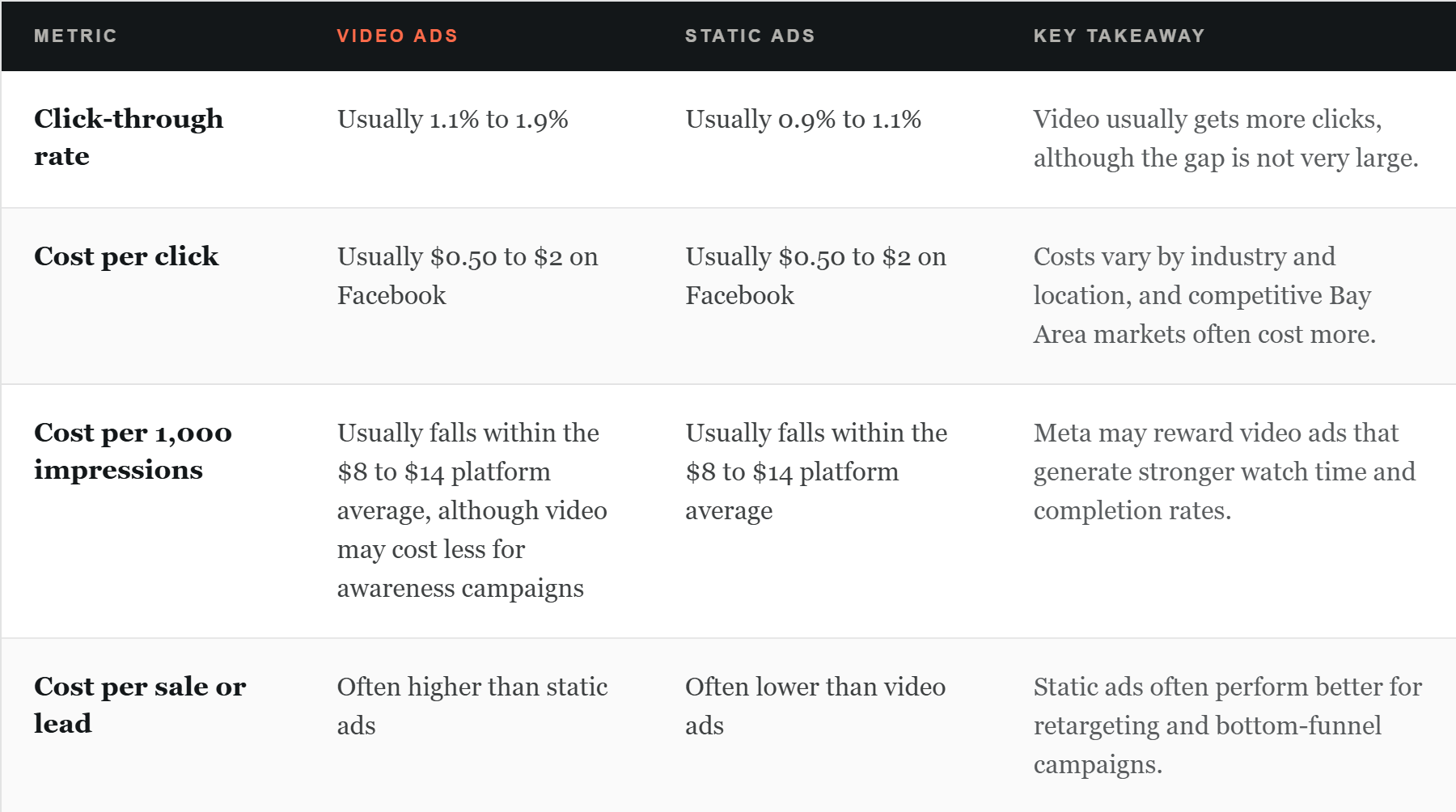
Image credit: Peakbound.studio
So what's the takeaway? Video is usually the stronger bet for building trust and standing out in a pricey market like the Bay Area. But it pays off fastest with a strong landing page video. Build one to catch that extra attention. Don't just send people to a plain homepage.
Best Practices for Bay Area Businesses Running Video Ads
A few habits set winning video ads apart from ones that quietly burn through your budget.
Win the first three seconds
Most feeds default to silent autoplay. So your opening shot has to earn attention on its own, without sound or a slow build-up.
Always add captions
Captions boost video completion rates by a lot. Most people watch social video with the sound off, especially on their phones.
Put a real person on camera
Ads with a human face get noticeably more clicks than product-only or graphic-only ads. That's a real edge for local businesses. Think of a Bay Area coffee roaster, contractor, or fitness studio. They can put a real face and voice behind their brand instead of using stock photos. This is exactly the strength of a well-made customer testimonial video.
Favor real over polished
Interview-style videos do well because they feel native to the platform, not like a typical ad. This helps businesses without a big budget. A well-shot, honest chat often beats an overly polished commercial.
Keep it short
Shorter videos, around 15 seconds, hold attention and finish more often than longer ads. This is especially true with cold audiences. It's the same idea behind a good social media video.
Pair every video ad with a landing page
Send video ad traffic to a page built around that ad's exact message, not a general homepage. It's one of the most reliable ways to turn extra attention into real leads.
Frequently Asked Questions
Do video ads convert better than static ads?
Video ads usually bring in more clicks and engagement. But static ads often convert at a lower cost per sale, especially in retargeting. So it depends on what you're measuring: engagement or cost.
Are video ads worth the extra cost for a business?
Usually, yes. This is especially true for a Bay Area business competing in a busy, pricey market where trust matters more than raw impressions. Video's engagement edge tends to beat its higher cost once you pair it with a landing page built to convert that attention.
What's the average cost of Facebook or Meta ads for a business in the Bay Area? Facebook and Instagram ads typically run $0.50–$2 per click and $7–$15 per 1,000 impressions nationally. Bay Area businesses often pay toward the higher end of that range. Why? Local competition for high-intent keywords.
Should a business start with static or video ads?
Most businesses get the best return by testing their message fast and cheap with static ads first. Then, once they know what works, they invest in a documentary-style or testimonial video.
The Verdict
For most Bay Area businesses, video ads win on the things that build long-term brand value: engagement, trust, and standing out in a pricey, sharp market. But static ads still earn their place.
They're great for fast testing, retargeting, and simple, price-driven offers. The smartest move isn't picking one format forever. It's this: use static to test fast and cheap. Then invest in video, ideally one with a real person telling a real story, once you know which message is worth scaling.
Action step: If you're only running static ads right now, try this. Test one honest, interview-style video ad against your best static ad. Pair it with a landing page built around that same message. Then compare results over a full testing cycle before you shift your budget. If you'd like help mapping out that first test, get in touch. We can talk through what would work best for your business.